How to Make Perfect Persian Restaurant-Style Rice (Polo)
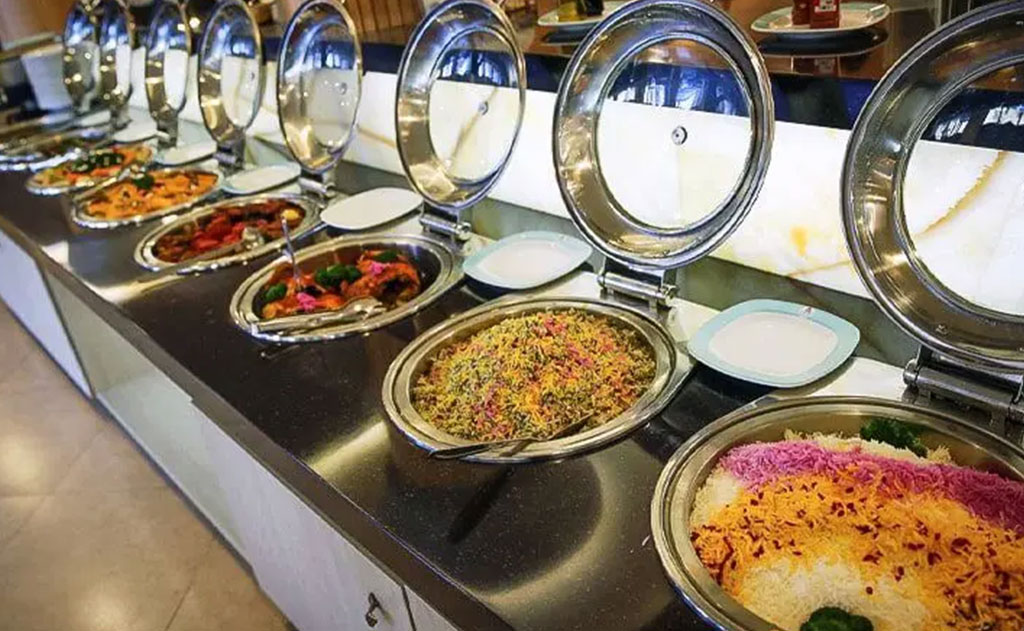
People around the world recognize Persian rice for its quality. When you enter a restaurant and order Iranian food, one of the most important signs of choosing a quality restaurant is seeing a perfectly cooked, aromatic, and delicious rice dish. Cooking restaurant-style Persian rice requires several key points, which I have written for you here. If you read this article to the end and follow every detail carefully, I promise you will have a fragrant, elegant, and beautifully cooked rice dish on your table.
Types of Iranian rice (polos)
People love Persian rice for its aroma and flavor, and they enjoy it not only plain with stews but also in many other varieties.Some of these include: dill rice(PoloShevid), herb rice(Sabzi Polo), lentil rice(Adas Polo), green bean rice(Lubia Polo), Tahchin, Zereshk polo (barberry rice), carrot rice(Havih Polo), Shirazi cabbage rice(Kalam Polo Shirazi), mung bean rice(PoloMash), fava bean rice(Baghali Polo), Estamboli polo (tomato rice), reshteh polo (noodle rice), jeweled rice (Morasa polo), southern shrimp rice(Meygu Polo), fish rice(Polo Mahi), Tehran-style “Dam-pokhtak”, Shir Berenj, Qanbar polo from Shiraz and Doshameh polo.
This website teaches all of these variations, and you can visit the ‘rice’ category to choose and cook any type of mixed rice you like.
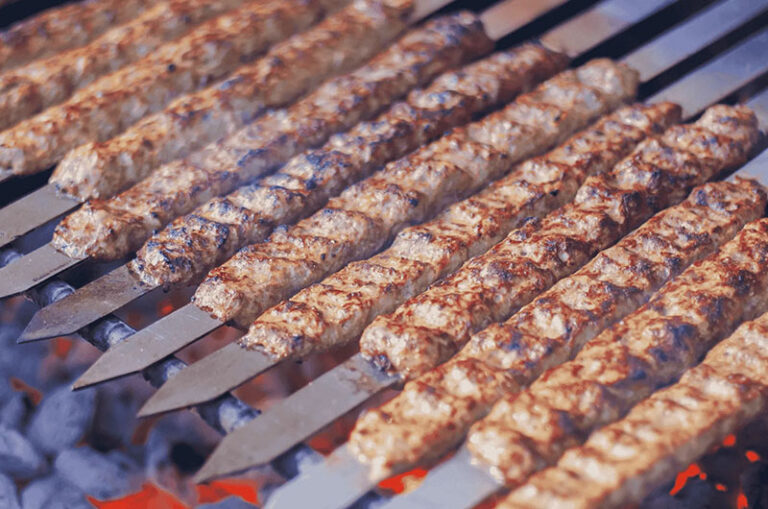
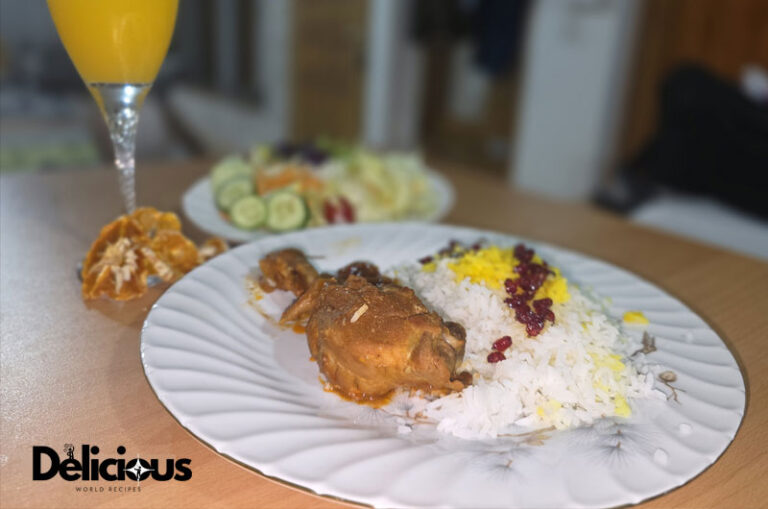
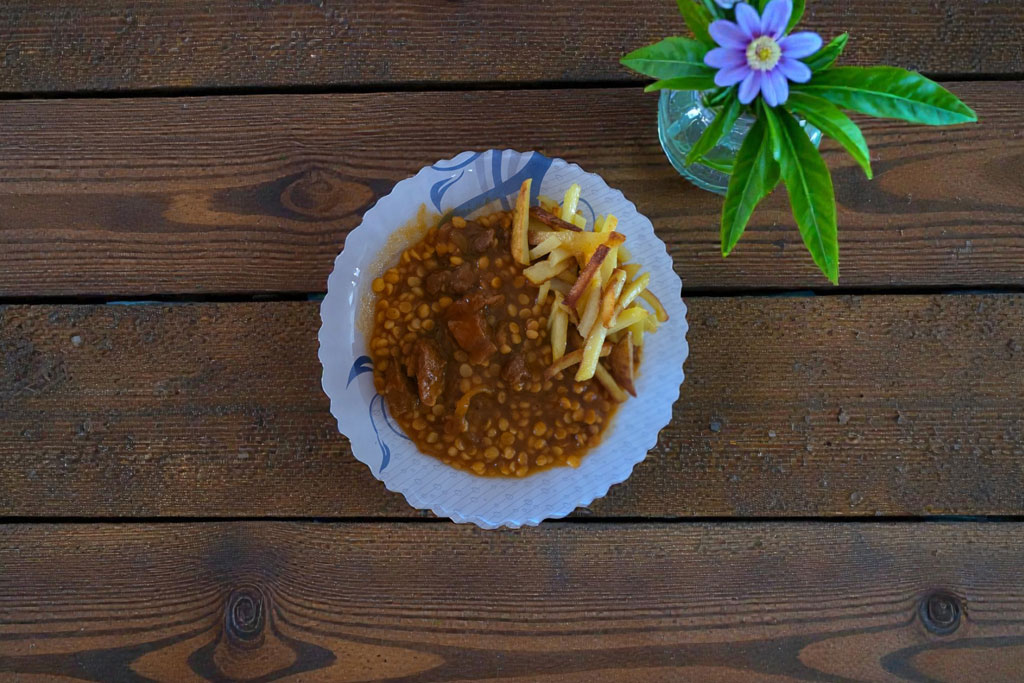
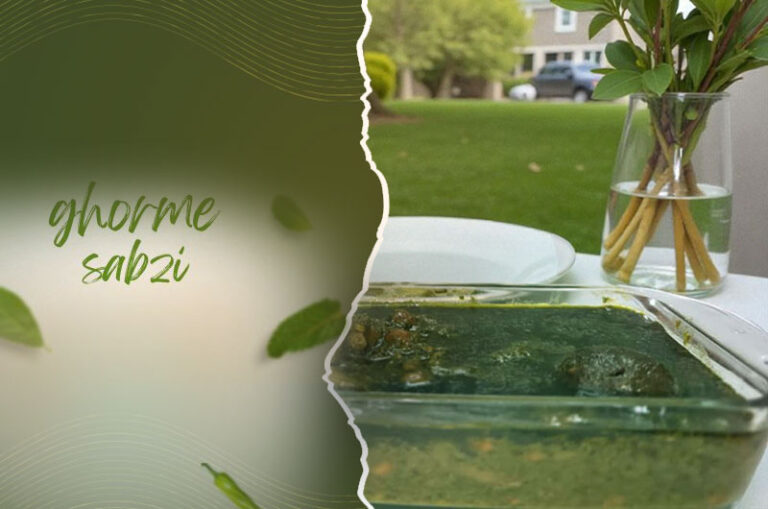
People usually serve rice with Persian stews such as Gheymeh, Khoresht-e Karafs, or Ghormeh Sabzi, or with different types of kebab. You can visit their dedicated posts to see the recipes for these stews and kebabs
Note that this method is specifically for steamed Persian rice (Chelow). Rice cooked as Kateh (absorption method) has a different preparation, which I have explained in a separate post.
essential points for a perfect Persian rice (Polo)
The first and most important point is choosing high-quality Iranian rice. Premium Iranian rice varieties such as Tarom, Hashemi, or Dom-siah are among the best choices, offering the traditional aroma and flavor expected from authentic Persian cuisine. If you cannot find these brands, don’t worry; in my article titled “Signs of a Good Rice,” I have explained how to identify and choose high-quality rice.
Another important factor is choosing the right pot.
choose a pot that meets two conditions: make sure it’s large enough for the rice to move freely in boiling water, and check that its bottom and sides are smooth. A damaged pot will make the tahdig stick and ruin the restaurant-style result.
The next important point relates to washing the rice. Wash the rice until the water running over it becomes completely clear. Be sure to wash it with cold or at most lukewarm water so the grains do not become soft and fragile. The starch removed through washing is only the surface starch, which is exactly what we want, because it helps the rice become fluffy, prevents grains from sticking, improves the tahdig, and ultimately helps you achieve that ideal restaurant-quality rice.
Using a proper colander is also very important. In the rice cooking instructions, I have explained what features a good colander should have. Make sure to read that section carefully.
Recommended Colanders for Rice Cooking:
Some links in this article are affiliate links, which means I may earn a small commission if you buy through them — at no extra cost to you
Stainless Steel Colander 24cm
Stainless Steel Colander 24cm no2
The remaining tips are explained during the cooking steps. Please read carefully and then cook your rice. If you are satisfied with the final result after following these techniques, I would be happy if you leave a comment—your feedback gives me energy to create more posts.
Make Perfect Persian Restaurant-Style Rice
Cuisine: AmericanDifficulty: Easy8
servings30
minutes20
minutes390.5
kcalThis has become a Friday night tradition in our home! We hope you enjoy it as much as we do.
Ingredients
4 cups High-quality, uniform rice
1/3 cup Salt
as needed Water
6–8 tablespoons Oil
4–5 tablespoons Concentrated brewed saffron
4–6 tablespoons Pistachio slivers (optional)
2 tablespoons Butter(optional)
Directions
- Step One: Preparing the Rice
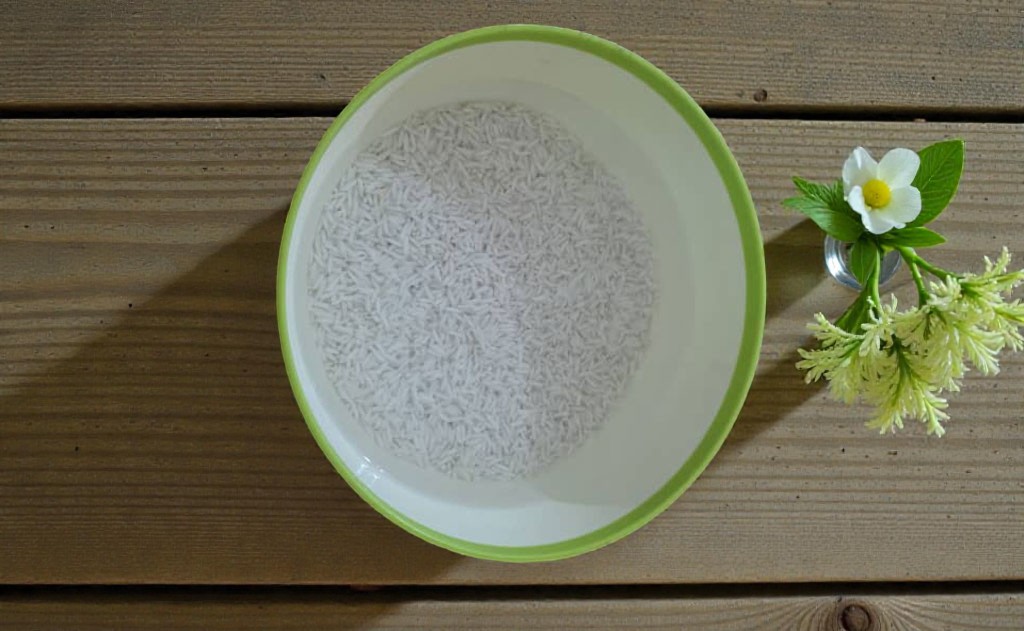
Clean and wash the rice. As mentioned earlier, washing must be done with cold water so the grains do not soften or break. Continue washing until the water becomes completely clear. Then let the washed rice soak in water for 2 to 3 hours.
Do not soak the rice for more than 3 hours; otherwise, the grains will become too soft and fragile, and the final result will not be the beautiful “separate-grain” Persian rice you want.
If you skip soaking altogether, the grains will not cook evenly, the chances of sticking and breaking increase, and the cooking time becomes longer. The result will not be a proper steamed Persian rice. - Step Two: Boiling the Rice
After the soaking time has passed, place a pot of water on heat and allow it to reach a strong rolling boil. The water must not be merely near boiling—it must be bubbling vigorously so that when the rice is added, the shock helps the grains open and stretch.
At this stage, add the salt.
If you add salt too early, the water becomes heavy and takes longer to boil.
If you add it after adding the rice, the salt does not have enough time to penetrate the grains.
So add the salt when the water is fully boiling, then pour in the rice. The heat shock will help separate the grains and improve their texture. - Step Three: Draining the Rice
When the rice reaches the following condition, it is time to drain it:
• The outside of the grain is fully cooked
• The center is slightly firm (not raw and not mushy)
• When you cut a grain in half, the center is still slightly opaque
• It does not mash easily between your fingers
• The grains have stretched but have not broken apart
Choosing a proper colander at this stage is extremely important and is one of the main differences between home-cooked rice and restaurant-style rice.
Plastic colanders soften with hot water and are not suitable.
If the holes are too small, the water drains slowly and the rice becomes mushy.
If the holes are too large, the grains fall through.
Choose a colander with medium-sized holes.
If the colander has no base and sits directly on the sink, water will re-enter the rice and make it mushy.
Depth is also important; if the colander is too shallow, the rice compresses and grains break.
Restaurants usually use colanders with a wide diameter so steam and water escape quickly without damaging the grains.
After pouring the rice into the colander, shake it gently to separate the grains. This is another key tip in restaurant-style rice cooking.
Use a deep stainless steel colander to drain the rice evenly. - Step Four: Cold-Water Shock
Immediately after draining, within 3 to 5 seconds, pour 2 to 3 cups of cold water over the rice. This thermal shock stops the cooking process and prevents the rice from becoming mushy during steaming.
Do not use too much cold water, or the rice will become too cold and dry, reducing steam efficiency during the final cooking stage.
But if you use too little, the thermal shock will not be effective.
Bake for 18-22 minutes, or until golden brown. Remove from oven and top with fresh cilantro. - Step Five: Transferring Rice Back to the Pot for Steaming
This step includes several important restaurant-style techniques.
First, dry the pot completely and wipe every part with a clean cloth so that no moisture remains. Excess moisture leads to improper steaming and results in soft, wet rice.
Do not return the rice from the colander directly into the pot. Use a rice spatula and gently spoon the rice into the pot so the grains remain separated.
Do not push the spatula in from the sides, as this breaks the grains.
Before adding rice, pour a thin layer of oil into the pot—just enough to lightly coat the bottom, not more.
After adding the rice, pour the required amount of water (for 4 cups of rice, about 2 cups of boiling water plus 2 to 4 tablespoons of oil) from the sides of the pot, not the center.
Pouring water into the center compresses the rice.
Steam circulation happens more effectively from the sides, so water must enter from there.
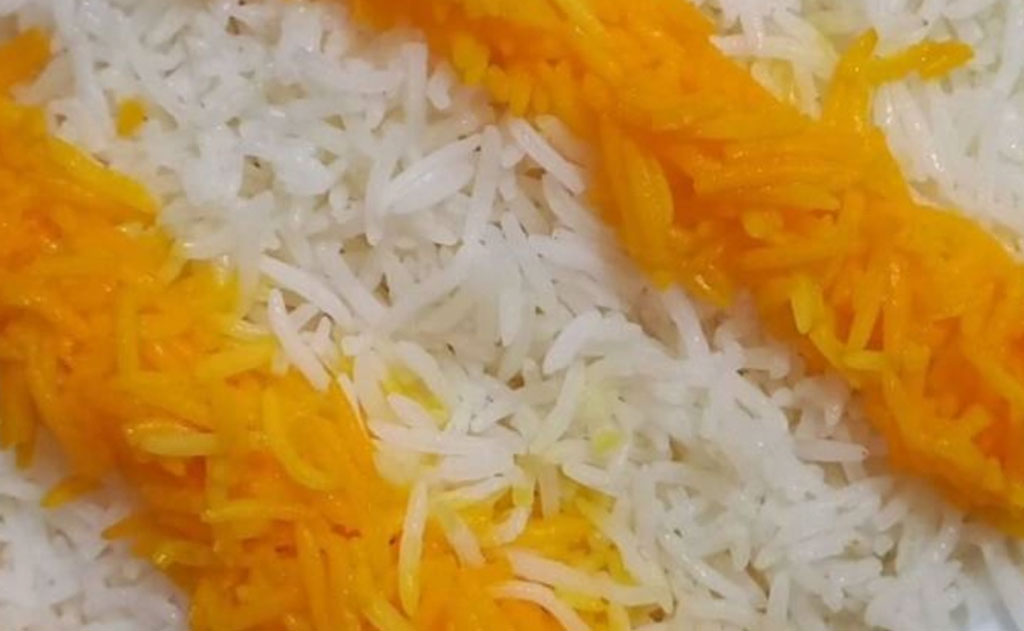
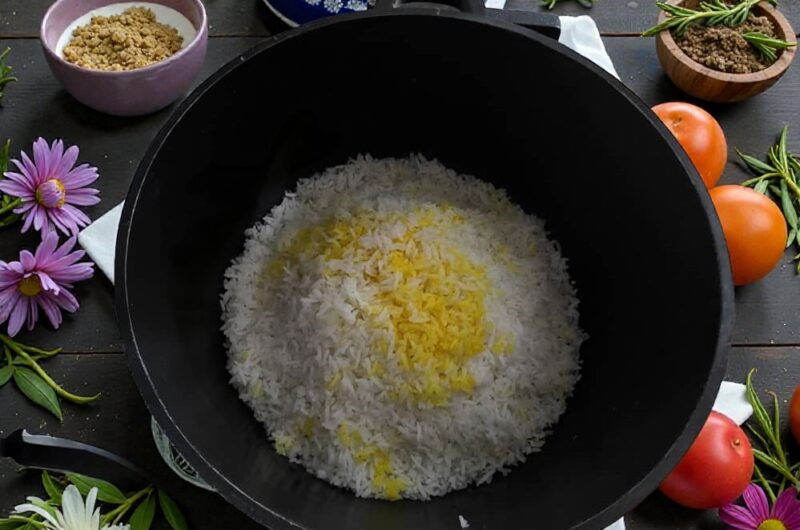
At this stage, you may prepare some saffron rice and place it in the center of the pot—just like restaurants—to enhance appearance when serving. - Step Six: Steaming the Rice
“In the final step, make a few small gaps between the rice using a spoon, then cover the pot and let it cook a little longer. At this stage, place the lid on the pot for 30 seconds to one minute while the heat is medium-high to create initial steam.
Then reduce the heat, place a heat diffuser (flame tamer), and cover the pot with a cloth-lined lid (damkoni).
Without a damkoni, the rice will not become restaurant-quality; excess moisture will not be absorbed, and the top layer will dry out.
Do not open the lid during steaming.
After about 30 minutes, remove the lid. At the end of cooking, turn off the heat and let the rice rest for five minutes so the moisture distributes evenly throughout. - Step Seven: Garnishing the Rice
For garnish, take some of the top layer of the steamed rice and place it in a large bowl. A small bowl breaks the grains.
Pour the brewed saffron into the bowl first, then gently add the rice on top so the grains do not break or mash.
Mix using a fork, not a rice spatula, as the spatula breaks the grains.
Lightly sauté the pistachio slivers in butter or rosewater with a touch of sugar so they are neither raw nor overcooked.
Finally, garnish your rice with saffron rice and pistachio slivers.
Enjoy your meal.
Notes
- 🟩 Reader Gift
Make sure to send me a photo or video of your cooked Polo so I can feature the best submissions under this post.
The best photo will receive a beautiful and delicious PDF cookbook as a gift.
Just be sure to enter your email address correctly so I can send it to you.